

Introduction
This post will go through the fundamental seven stages of HACCP regulation for your foodservice industry. Clearing out the jargon and introducing you to the concept.
The term HACCP stands for Hazard Analysis and Critical Control Points and is a food safety management technique utilized worldwide. Its purpose is to successfully avoid bio, chemical, and exposure to hazardous materials at all stages of a food’s life cycle, from raw materials to consumption flow.
NASA first devised the idea to assure the manufacturing, processing, and preservation of safe space meals. HACCP has been using a certain standard called the de facto standard protocol for global food safety and hygiene in worldwide food commerce since the 1960s.
The following context will help you comprehend the information about the seven stages available in the HACCP.
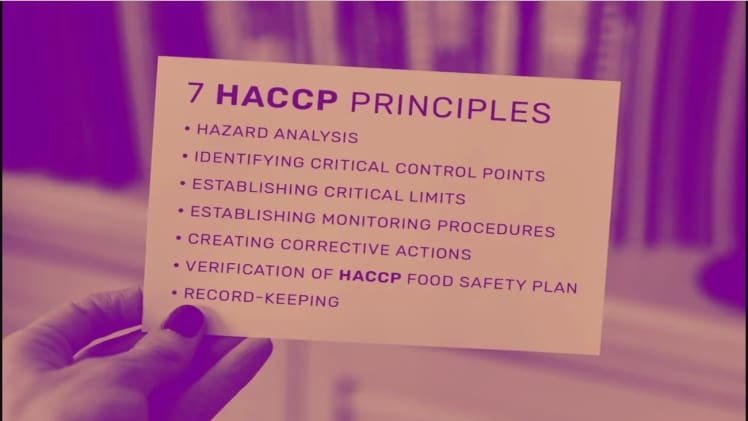
According to your study, the HACCP standards are built on the following seven key phases. They allow us to understand better, analyze, and mitigate problems that might jeopardize food safety across the food business.
1. Perform a Risk Evaluation
It would help if you studied your procedures to find where substantial food-borne diseases are likely to arise. Hazards might be biological, chemical, or physical. The relative risk of each hazard must be assessed, and processes must be developed to prevent, eliminate, or reduce the hazards. Therefore, the HACCP training will ensure the risk evaluation as a part of the mandatory step.
2. Determine the Key Control Points
Control strategies can be adopted, and risks can be minimized, removed, or lowered to reasonable levels at critical points in your procedure.
When a danger cannot be handled at a later level, you consider a step to be a crucial control point. Your specific procedure determines the number of functional points. It is feasible to control many dangers with a single critical control point, or several must be used to manage a single hazard.
3. Define Critical Limitations
The following step is to define thresholds for the chokepoints. They provide a predetermined level that must be met. They are founded on scientific research or legislative norms.
Temperatures, pH ratios, and visual looks are frequently used as criteria for those limitations. If possible, utilize an alert system to notify you when a critical limit will fail. Using HACCP training, one can understand the limitations and the critical points in your process.
4. Keep an eye on control activities
Monitoring is critical to the success of any HACCP strategy. It may include human or computerized monitoring and assessments to ensure critical limits are reached. It must provide constraints for each critical control point. The procedures must enable the speedy implementation of remedial actions.
5. Implement Diagnostic Actions
When a vital control point deviates, remedial steps must be implemented. Predetermined procedures are used to avoid, remove, or minimize dangers to a tolerable level. It is critical to act quickly to prevent potentially harmful food from being discharged. The HACCP training will incorporate the necessary steps for diagnosing the actions and other processes as part of food safety.
6. Create Reviews And audits
You must examine and confirm that all documented phases in your processes are running as planned regularly. This might include an evaluation of your data, machine servicing, or ensuring that measures have the desired impact. To keep your products and consumers safe, your HACCP procedures must be successful.
7. Implement Document-keeping Procedures
The very last but not least critical stage is to keep detailed records of your strategy and practices. It demonstrates that you implemented the necessary procedures and handled the product safely.
The data assist you in analyzing potential issue areas and demonstrating how successfully you have been minimizing threats.
Conclusion
The HACCP training will assist the individuals in understanding the stage-wise data and critical points that need to be taken care of while maintaining food safety.
